
In-person therapy in Rifle, Colorado
Sandtray Therapy
Beyond words. Beneath the surface. A different pathway to healing.
Not every experience can be explained through words. Some experiences are felt in the body, expressed through behavior, represented through imagery, or experienced as emotions we struggle to understand.
Perhaps you know why you feel the way you do, yet something continues to feel stuck. Perhaps your child is communicating distress through behavior rather than language. Perhaps you are carrying experiences that feel too overwhelming or complicated to describe.
At Illuminate Play Therapy & Counseling, we offer specialized Sandtray Therapy that integrates symbolic expression, sensory experiences, somatic awareness, and trauma-informed care.
Our practice offers traditional Sandtray Therapy, the innovative Healing Bridge Sandtray (also known as the Dog Bone Sandtray), and Body Sandtray interventions, allowing us to individualize the therapeutic experience across the lifespan.
Your story deserves to be expressed, even when words are not available.
What Is Sandtray Therapy?
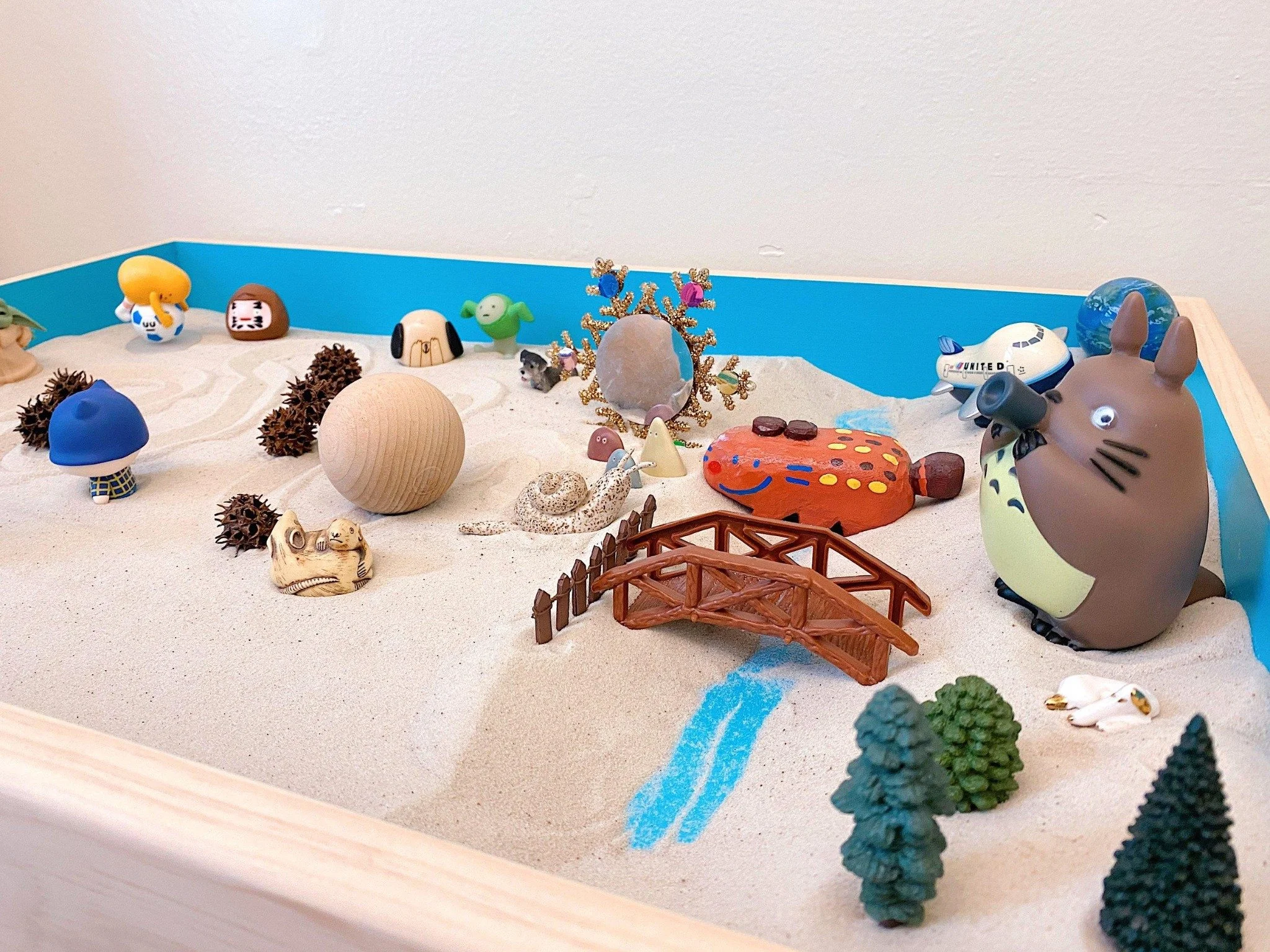
Sandtray Therapy is an experiential, expressive therapeutic modality that uses sand, miniature figures, natural objects, and symbolism to explore an individual’s internal experiences.
With historical roots in the work of Margaret Lowenfeld and Dora Kalff, sand-based therapies have evolved into a variety of clinical approaches used with children, adolescents, adults, couples, and families.
During Sandtray Therapy, clients are invited to select objects and arrange them within a tray of sand. These objects may represent relationships, emotions, experiences, challenges, strengths, memories, or aspects of themselves.
The process allows clients to create a three-dimensional representation of their internal world, making abstract or complicated experiences more tangible.
The therapeutic experience involves much more than the finished scene. Selecting objects, interacting with the sand, arranging symbols, noticing physical sensations, and reflecting on the experience can all become meaningful components of treatment.
There is no correct way to create a sandtray. You can take part without prior experience or artistic training.
How Sandtray Therapy Offers a Different Way to Express Yourself
Traditional talk therapy primarily relies on verbal communication, reflection, and cognitive understanding. While these are valuable components of treatment, they are not the only pathways to emotional healing.
Sandtray Therapy incorporates multiple forms of expression, including:
- Sensory and tactile experiences
- Visual and spatial exploration
- Symbolic representation
- Emotional awareness
- Creative expression
- Somatic and body awareness
- Reflective processing
- Relational exploration
This combination can be particularly valuable when language feels limiting or when experiences are difficult to organize into a verbal narrative.
Sandtray allows individuals to explore experiences outside of themselves, creating opportunities to observe patterns, recognize strengths, consider new possibilities, and develop deeper understanding.
Rather than having to explain everything happening internally, you are invited to explore it through experience.
Three Specialized Sandtray Experiences
At Illuminate Play Therapy & Counseling, we recognize that different therapeutic needs may benefit from different approaches. Our specialized sandtrays allow us to adapt treatment to the individual rather than expecting the individual to adapt to a single therapeutic method.
Traditional Sandtray Therapy

Exploring your inner world through symbolism and sensory experience.
Traditional Sandtray Therapy provides a contained space for clients to create symbolic representations of their experiences using sand and a diverse collection of miniature objects.
Our collection includes figures representing people, animals, relationships, nature, buildings, transportation, fantasy, spirituality, emotions, protection, obstacles, and abstract concepts.
A traditional sandtray may represent a person’s current circumstances, relationships, emotional struggles, internal conflicts, hopes, fears, or imagined possibilities.
This approach may support individuals experiencing:
- Trauma and adverse childhood experiences
- Anxiety, depression, and emotional overwhelm
- Grief and loss
- Attachment and relationship difficulties
- Identity and self-esteem concerns
- Family conflict
- Significant life transitions
- Emotional regulation challenges
- Difficulty communicating through words
- Personal growth and self-discovery
The tray offers an opportunity to approach complicated experiences with curiosity rather than judgment.
The Healing Bridge Sandtray — The Dog Bone Tray
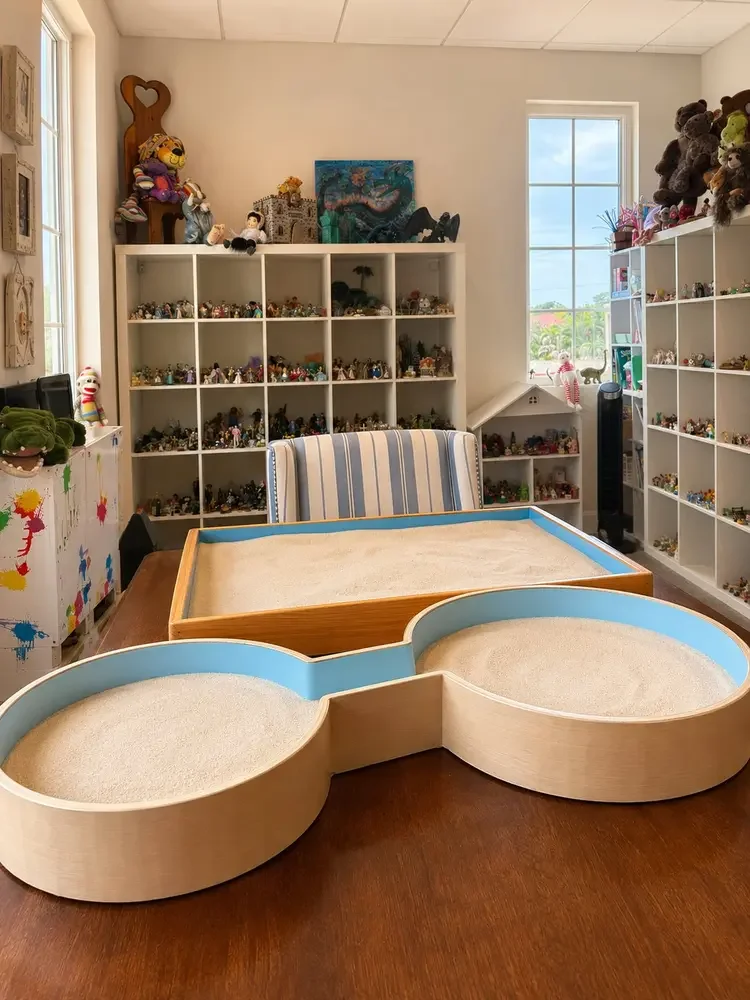
Connecting experiences that feel separate, divided, or difficult to reconcile.
The Healing Bridge Sandtray, affectionately known as the Dog Bone Sandtray, was developed by Dr. Mindy Parsons, a specialist in sandtray and play therapy.
Originally created to support children adjusting to divorced or separated households, this uniquely shaped tray contains two larger spaces joined by a central passageway.
Unlike a traditional rectangular sandtray, its design invites exploration of connection, separation, movement, contrast, and transition.
At Illuminate Play Therapy & Counseling, we incorporate the Healing Bridge Sandtray into therapeutic work with children, adolescents, adults, couples, and families when clinically appropriate.
Two homes. One child. A connected story.
For children navigating divorce, separation, adoption, or foster care, life can sometimes feel divided between different homes, caregivers, expectations, and emotional experiences.
The Healing Bridge Sandtray provides a space where children may represent those different experiences without being asked to choose sides, compare caregivers, or determine which home is better.
Children may explore what feels familiar, what feels different, what they miss, what brings comfort, and what helps them navigate transitions.
The connecting space can also provide opportunities to explore movement between experiences, emotional continuity, and the relationships or resources that support them.
Beyond childhood and family transitions, the Healing Bridge Sandtray may be used to explore:
- Life before and after a traumatic experience
- Grief and life following a significant loss
- Biological and adoptive family relationships
- Foster care and placement transitions
- Emotional distance and relational connection
- Conflicting emotions or internal experiences
- Past experiences and future hopes
- Relationship ruptures and possibilities for repair
- Medical diagnoses and changes in identity
- Recovery and significant life transitions
- The difference between how we appear externally and how we feel internally
The connecting space does not have a predetermined meaning. Each client determines what the spaces and their relationship represent.
Sometimes healing is not about leaving one part of our story behind. It is about finding ways to hold different parts of our story together.
The Body Sandtray — Somatic & Embodied Exploration
Giving physical sensations and emotional experiences a visible form.
Have you ever experienced anxiety as a tightness in your chest? Grief as heaviness in your body? Fear as a knot in your stomach? Or overwhelming stress that leaves you feeling disconnected, numb, or frozen?
Our emotional experiences and physical sensations are interconnected. Yet, identifying and communicating what we experience within our bodies can be challenging.
At Illuminate Play Therapy & Counseling, we incorporate a specialized Body Sandtray into our somatic and experiential therapeutic work.
The Body Sandtray offers a creative way to explore the relationship between bodily sensations, emotions, personal experiences, and nervous system responses.
Using miniature figures, symbols, textures, and intentional placement, clients may create a visual representation of what they are experiencing physically and emotionally.
This may include exploring where tension, heaviness, comfort, fear, energy, numbness, or a sense of safety is experienced within the body.
The Body Sandtray may support the exploration of:
- Somatic symptoms associated with stress and anxiety
- Physical sensations connected to emotional experiences
- Medical trauma and difficult healthcare experiences
- Developmental and preverbal trauma
- Panic and nervous system dysregulation
- Emotional numbness and disconnection
- Body image and changes in physical identity
- Grief and embodied experiences of loss
- Chronic stress and burnout
- Personal boundaries and bodily autonomy
- Internal resources and experiences of safety
- Interoception — awareness of internal bodily sensations
- Reconnection with the body following difficult experiences
For children, the Body Sandtray can offer a developmentally appropriate way to identify physical sensations and communicate emotions they do not yet know how to describe.
For adults, it can offer another pathway toward understanding patterns of tension, disconnection, emotional overwhelm, and protective responses.
Rather than asking only, “What are you thinking?” we also create opportunities to explore:
What are you noticing in your body?
Where do you experience that feeling?
What might comfort or support look like?
What helps you experience a greater sense of safety?
The Body Sandtray is not used to diagnose medical conditions or determine whether an unknown traumatic event occurred. Instead, it provides a therapeutic space for exploring present experiences with curiosity, compassion, and choice.
Healing involves more than our thoughts. It also involves how we experience ourselves within our bodies.
Sandtray Therapy for Children
A language beyond words.
Children naturally communicate through play, movement, behavior, imagery, and imagination.
When children experience trauma, grief, separation, attachment disruptions, or overwhelming emotions, they may not have the developmental ability to organize those experiences into words.
Sandtray Therapy offers an alternative form of communication that honors the child’s developmental needs.
Children can explore themes of safety, protection, belonging, family, loss, power, connection, and emotional experiences without being pressured to provide verbal explanations.
Sandtray Therapy can be particularly supportive for children navigating adoption, foster care, divorce, medical trauma, developmental trauma, emotional regulation difficulties, and significant family transitions.
Our therapists prioritize the child’s individual pace, emotional safety, autonomy, and developmental abilities throughout treatment.
Sandtray Therapy for Adolescents
Making space for what is difficult to say.
Adolescence can bring complicated emotional experiences, changing relationships, identity development, social pressure, and uncertainty about the future.
For teenagers who find traditional talk therapy uncomfortable, overwhelming, or repetitive, Sandtray Therapy offers a different opportunity for expression.
Adolescents may explore their relationships, personal boundaries, sense of identity, family dynamics, academic pressures, experiences of trauma, and hopes for the future through symbolic representation.
Sandtray Therapy can also provide opportunities to explore difficult emotions without feeling pressured to immediately explain or justify them.
Sandtray Therapy for Adults
Understanding your story is not always the same as feeling healed.
Many adults enter therapy with significant insight into their experiences.
They understand their childhood, recognize their relationship patterns, identify their triggers, and know intellectually why certain experiences continue to affect them.
Yet, they may still experience anxiety, emotional overwhelm, physical tension, relational difficulties, or a persistent sense of feeling stuck.
Sandtray Therapy offers an alternative to relying exclusively on cognitive understanding.
Through sensory engagement and symbolic exploration, adults may discover different perspectives, recognize internal conflicts, explore emotional needs, and develop a deeper connection with themselves.
Adult Sandtray Therapy may be particularly meaningful for individuals navigating childhood trauma, complex PTSD, medical trauma, grief, relationship difficulties, major life transitions, and emotional disconnection.
You do not need to be creative, artistic, or comfortable with play to participate.
Sandtray Therapy is not about making art. It is about creating space for your experiences.
Sandtray Therapy for Couples & Families
Seeing relationships from a different perspective.
Sometimes couples and families find themselves repeating the same conversations without developing a deeper understanding of what each person is experiencing.
Sandtray Therapy provides a visual and experiential way to explore the dynamics beneath those conversations.
Through individual or collaborative sandtray experiences, couples and families may explore:
- Emotional needs and expectations
- Communication patterns
- Attachment and relational experiences
- Family roles and responsibilities
- Boundaries and personal space
- Parenting challenges
- Emotional distance and disconnection
- Shared grief or significant transitions
- Relationship strengths and hopes for the future
The Healing Bridge Sandtray may be especially helpful when exploring differences in perspectives, emotional experiences, and possibilities for connection.
Rather than focusing solely on who is right or wrong, experiential work can create opportunities for curiosity, empathy, and understanding.
Sandtray Therapy for Neurodivergent Individuals
Traditional therapy can sometimes place significant demands on verbal processing, emotional identification, sustained attention, and abstract thinking.
For some individuals with ADHD, autism, sensory processing differences, or difficulty identifying and describing internal emotional experiences, Sandtray Therapy may offer a more accessible form of therapeutic engagement.
Its visual, tactile, and interactive nature allows clients to participate in ways that may feel more natural and supportive of their individual processing styles.
Our approach is neurodiversity-affirming and adaptable to individual sensory preferences, communication needs, and emotional experiences.
Clients are never required to touch sand or participate in sensory experiences that feel uncomfortable.
Sandtray Therapy, Trauma & the Nervous System
Integrating the mind, body, and emotional experience.
Trauma can influence how we experience relationships, emotions, bodily sensations, safety, and the world around us.
Some individuals experience trauma-related distress through hypervigilance, muscle tension, emotional numbness, panic, disconnection, or difficulty remaining present.
Sandtray Therapy can offer a sensory and symbolic pathway for exploring these experiences.
Working with sand and miniature objects may provide opportunities for grounding, emotional awareness, present-moment engagement, and personal agency.
At Illuminate Play Therapy & Counseling, Sandtray Therapy may be integrated with:
- EMDR Therapy
- Somatic Therapy
- Brainspotting
- Trauma-Focused Cognitive Behavioral Therapy
- Play Therapy
- Theraplay® and attachment-based interventions
- Expressive arts
- Nervous system-informed interventions
This integrated approach allows us to individualize treatment based on the client’s developmental needs, emotional readiness, therapeutic goals, and personal preferences.
We believe healing should honor the whole person — not just their symptoms, thoughts, or behaviors.
What to Expect During a Sandtray Therapy Session
1. Arriving and establishing connection
We begin by checking in, identifying your needs, and determining which therapeutic approach may be appropriate for that session.
2. Choosing your therapeutic space
Depending on your needs, we may utilize a traditional sandtray, the Healing Bridge Sandtray, or the Body Sandtray.
3. Creating and exploring
You are invited to select miniature figures, interact with the sand, and create a representation of your experiences. Some activities may be open-ended, while others may include gentle therapeutic invitations.
4. Observing and reflecting
Together, we may explore what you notice about your creation, including emotions, relationships, patterns, physical sensations, or personal meanings.
You are not required to explain everything you create.
5. Integrating and grounding
We allow time to reflect, reconnect with the present moment, and identify any insights or resources that may be helpful beyond the session.
With your permission, your therapist may photograph the completed sandtray for confidential clinical documentation, when appropriate.
Throughout the process, your therapist provides a supportive, curious, and nonjudgmental presence.
Frequently Asked Questions
Is Sandtray Therapy just another form of play therapy?
Although sandtray is frequently incorporated into play therapy, it is also an expressive therapeutic modality used independently with adolescents, adults, couples, and families.
Do I need to know what the miniature figures represent?
No. You do not need to understand or explain the meaning of every object you select. Your personal associations and experiences guide the therapeutic process.
Will my therapist interpret my sandtray?
Your therapist may help you explore patterns, feelings, and personal meanings, but will not assume that specific symbols have universal meanings. Your sandtray belongs to you and your experience.
What makes the Dog Bone Sandtray different?
Its connected spaces offer opportunities to explore contrasting experiences, relationships, transitions, separation, and connection within one therapeutic environment.
What makes the Body Sandtray different?
The Body Sandtray emphasizes the relationship between emotional experiences and physical sensations. It can be incorporated into somatic and trauma-informed treatment to support body awareness, expression, and exploration.
Can Sandtray Therapy be used alongside EMDR?
Yes. Sandtray may complement different phases of EMDR treatment, including resource development, emotional exploration, and integration, depending on your individual treatment plan.
Can Sandtray Therapy help with experiences I cannot remember clearly?
Sandtray Therapy can help you explore present-day emotions, physical sensations, and relational patterns without requiring a complete verbal account of your past. It is not a method for recovering or verifying forgotten memories.
Do I have to touch the sand?
No. Your comfort, sensory preferences, and personal boundaries are respected throughout treatment.
Can adults benefit even if they have already participated in years of talk therapy?
Yes. Sandtray Therapy offers a different way to engage with experiences and may complement the insight and understanding developed through previous therapy.
Your Story Is More Than Words
At Illuminate Play Therapy & Counseling, we believe there are many pathways to healing.
Some begin through conversation.
Some begin through movement.
Some begin through connection.
And some begin with a handful of sand and the freedom to express what has been difficult to say.
Whether you are navigating trauma, supporting your child’s emotional development, rebuilding relationships, or learning to reconnect with yourself, our specialized Sandtray Therapy services offer a compassionate space for exploration and growth.
You do not have to explain your entire story to begin healing.
Experience specialized Sandtray Therapy at Illuminate Play Therapy & Counseling in Rifle, Colorado.